
Before a customer can try your supplement, they see its packaging. On a product page, that image needs to make the bottle recognisable, the label legible and the size of the pack understandable. In an advert, it also needs to attract attention and give the brand a distinct visual identity.
A clear image against a plain background helps someone examine a product. A carefully composed scene can place the same bottle within a morning routine or a sports setting. A consistent set of images helps customers recognise related products across a range. Preparing those assets deserves a place in the launch budget alongside packaging design and the online shop.
Why a full image library can become expensive
Producing an extensive image library through photography can involve samples, shipping, studio time, lighting, props and retouching. Adding another product or changing the packaging may require further work. Elaborate campaign scenes introduce additional costs, particularly when a brand needs several settings and many product variations.
Photography remains useful, and a straightforward shoot can be economical. The challenge grows when the business needs a large volume of consistent images, or needs them before finished products are available. Advanced 3D tools offer another way to plan that production, while AI can help with parts of the creative work.
WithoutCamera: one product, several marketing uses
WithoutCamera, a product visualisation studio by Viscato, provides a concrete example of how this approach works. Its services include photorealistic product images, CGI packshots, lifestyle scenes and animation. The studio builds digital products that can be reused across settings, finishes and marketing formats.
A suitable digital model allows the team to change the camera angle, adjust the lighting or place the product in another environment. With sufficient product information, visual production can also begin before a finished sample is available. WithoutCamera identifies CAD files, dimensions and reference materials as inputs for this work.
Its Princess Wave project shows what that means visually. A cream-coloured kettle and toaster appear together in a kitchen setting. Lighting reveals their ribbed surfaces, while bread, cups and the surrounding cabinetry establish a familiar context. Wider views present the collection; individual compositions give each appliance its own space.

Although these are appliances rather than supplements, the marketing principle transfers well: show the product clearly, then give it a setting relevant to the customer. For a supplement brand, that could mean a precise bottle image for the shop and a separate composition showing the packaging beside a breakfast setting. The product should remain easy to identify in both.
Where the cost savings come from
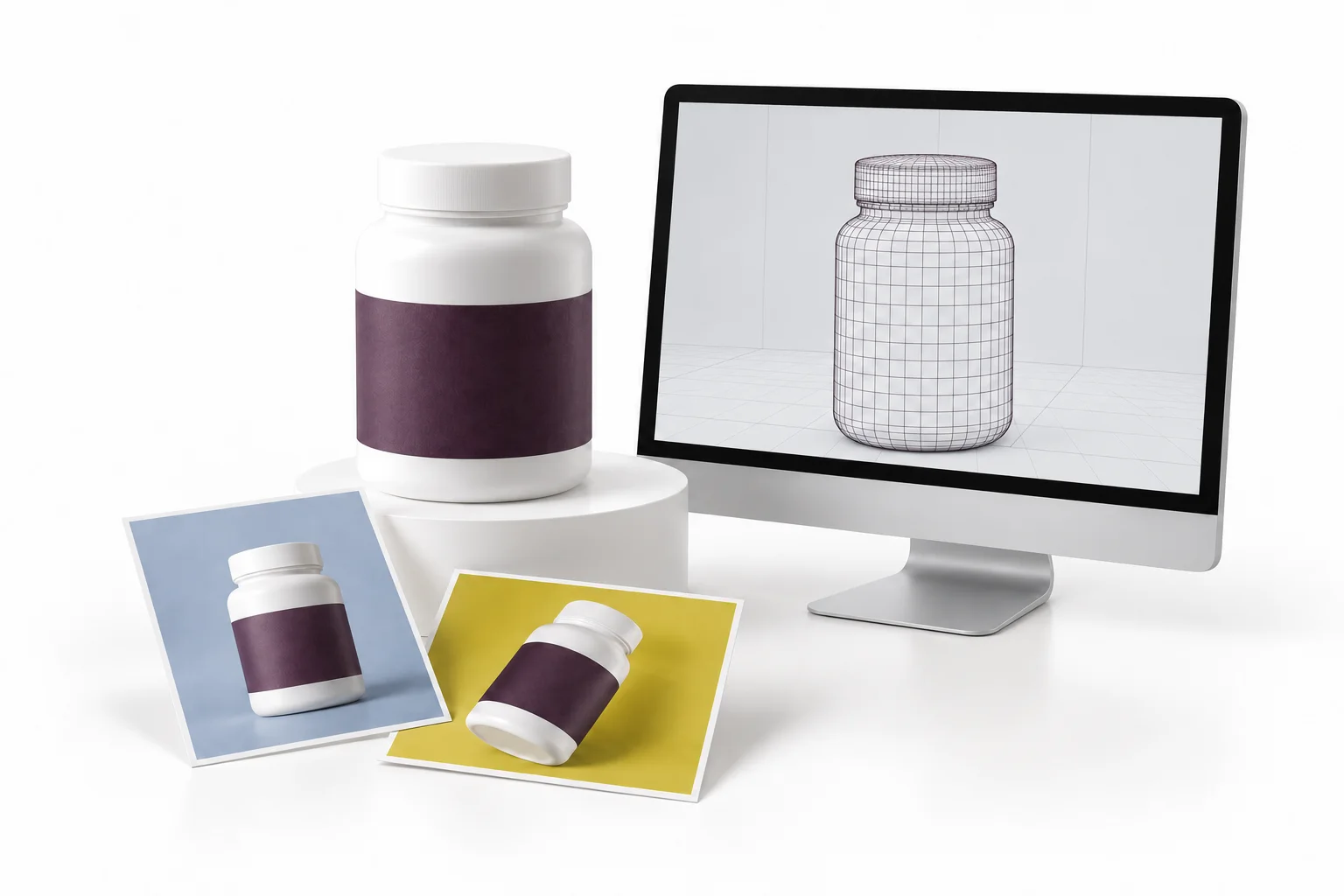
Consider a hypothetical range of three supplements using the same bottle with different labels. A shared digital bottle model could provide the starting point for individual product images, a group composition and campaign visuals. Each label and packaging variation would still need checking, but the team would have an existing asset to build on.
This reuse is the main economic argument. The first model requires work: its shape, materials, proportions and label placement must be accurate. Once approved, it can support further images without rebuilding everything from the beginning. A new backdrop or label variation can be developed from that foundation.
Savings depend on product complexity, the source files available and the number of assets required. A single straightforward photograph may cost less than constructing a detailed 3D model. Across a range that needs repeated updates, the balance can shift. Compare the cost of the planned image library and future adaptations, rather than judging the approach by the price of one image.
How the workflow works
WithoutCamera's product visualisation service and workflow describes three stages. First, the client supplies product files, references, intended uses and a deadline. If a 3D model is unavailable, dimensions, photographs and material references help the studio assess the modelling work. A complete brief allows it to quote, usually on the same day and no later than the next business day.
The team then agrees the visual direction and shares work through an online feedback platform. Two revision rounds are included. Approved images are delivered in the agreed formats, with timing confirmed as part of the scope. Angles, details and environments are planned around the placements where the images will appear.
For a brand owner, this makes the brief an important part of controlling costs. Knowing that you need a product-page image, a mobile advert and a wide website banner allows those compositions to be planned together. Discovering missing formats at the end creates avoidable revisions.
Where AI helps, and what still needs checking
AI can help explore creative directions, develop background concepts and assist with selected editing tasks. A small team can use it to compare visual ideas before commissioning finished campaign assets. That makes experimentation more accessible, although the quality and usefulness of the results still depend on the brief and review.
The product itself needs careful control. Generated imagery can alter lettering, invent packaging details or change proportions. A supplement image should match the actual pack, including its label and contents. A practical approach is to keep an approved photograph or accurate 3D render as the product reference and check any AI-assisted work against it.
This is a suggested approach for supplement brands, rather than a description of WithoutCamera's published workflow, which focuses on CGI and 3D production. Its example demonstrates the value of a controlled, reusable product asset; AI can be considered separately for tasks where it improves the result.
Give each image a job
An attractive image becomes more useful when it answers a specific customer question. A packshot helps shoppers inspect what they are buying. A range image makes the relationship between products clear. Campaign imagery gives the product a recognisable setting and must remain readable on a small screen.
WithoutCamera is a strong example of how to organise that work because it connects different marketing uses with a reusable production process. This can make professional product promotion more affordable as the image library grows. Sales performance still needs to be measured through the brand's own campaigns, rather than inferred from the appearance of a render.
For your next launch, list the images you need, their intended placements and the packaging variants you expect to introduce. Ask for a quote covering both the first set and later adaptations. You will then have a practical basis for choosing between photography, 3D and a combination of production methods.