

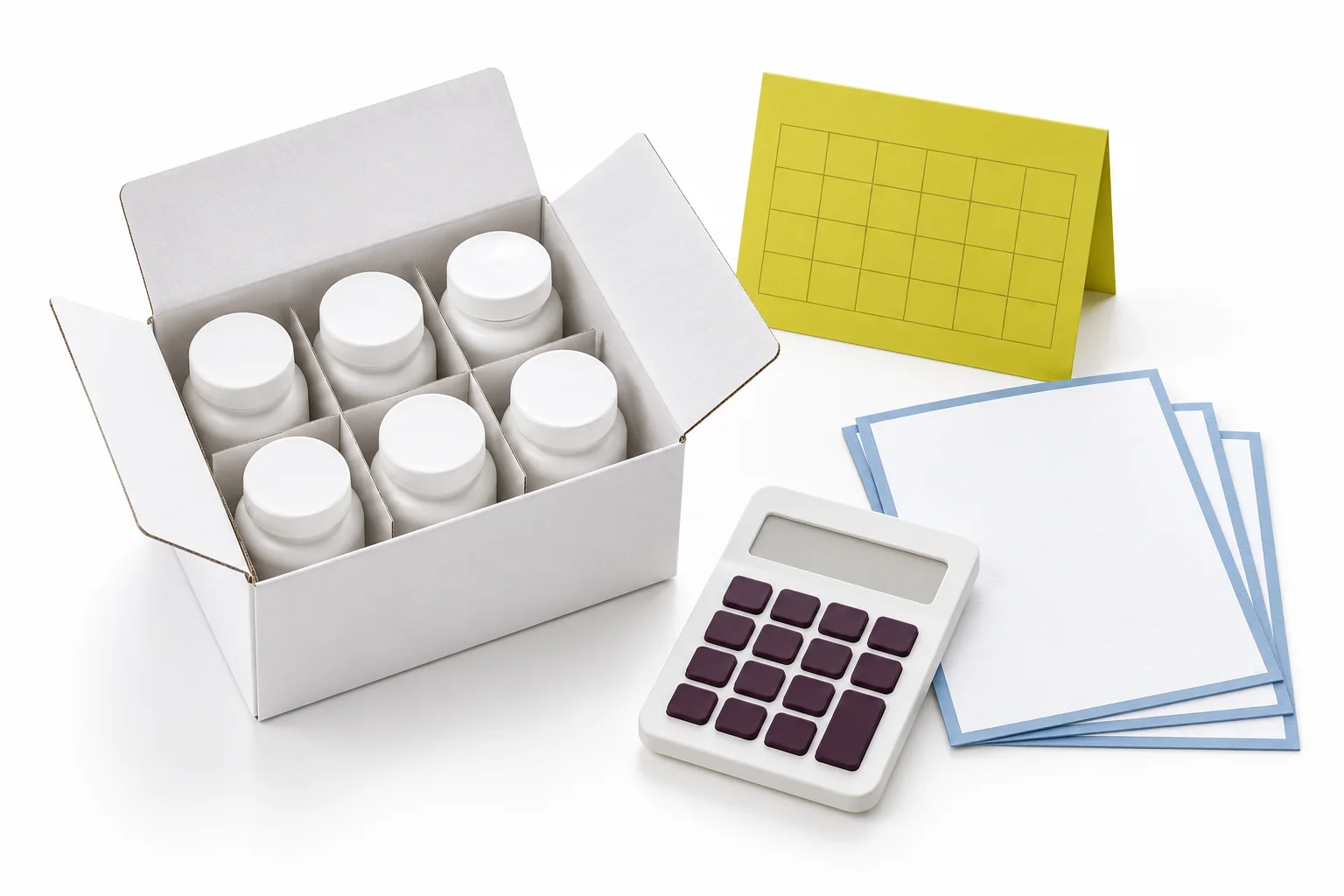
A quote for 25,000 capsules might describe roughly 417 bottles of 60 capsules. It might also exclude the bottles, labels and delivery. Until those details are clear, the headline price tells you little about the cash needed to launch.
Compare quotations for the same finished product, delivered to the same place. Then work out the additional cost of selling it.
Translate the minimum into retail packs
Manufacturers can state minimum order quantities in capsules, tablets, kilograms, sachets or finished packs. MOQ is simply shorthand for that minimum.
Supplement Factory's published examples include 25,000 capsules for certain capsule options and 300,000 gummies. These figures were checked during research on 31 October 2026. They describe one supplier's offer and need reconfirmation for a new order.
Dividing 25,000 by 60 gives about 417 bottle-equivalents. That is a calculation, not a promise that the factory will accept exactly 417 bottles. The final order must account for its packing requirements and agreed batch size.
The quote should state how many saleable packs you will receive and what each contains. It should also say whether each flavour, formula or pack size has its own minimum. A budget for one batch can quickly become a budget for several if you launch multiple variants.
What is included in the price?
Use the quotation to establish the following:
| Item | Detail to resolve |
|---|---|
| Formula | Existing product, adaptation or new development; specification version |
| Pack | Contents, container, closure, seal, label and any outer carton |
| Development | Samples, revisions and pilot work included |
| Testing | Tests and documents supplied for the order |
| Market support | Destination-specific label review or notification work, if offered |
| Delivery | Destination, freight charges and any customs arrangements |
A separate charge is not necessarily a problem. An unspecified charge makes planning difficult. Obtain a written total for the agreed order, with any remaining estimates identified.
Custom packaging can introduce its own minimum purchase. If the container or printed carton requires more units than the product order, establish who pays for and stores the remainder. A standard pack may be worth pricing as an alternative.
Calculate the cost of stock you can actually sell
Suppose a batch costs €6,000 and freight to your warehouse costs €300. If you receive 1,000 saleable packs, those two costs amount to €6.30 per pack.
This is a hypothetical calculation, not a typical factory price. It shows why the quantity and included charges matter. Development, extra testing or other inbound costs would need to be added if they were excluded.
For planning, divide the costs of bringing the order to your storage location by the expected number of saleable packs. Treat recoverable taxes separately from costs ultimately borne by the business, while allowing for their effect on cash flow.
The resulting figure is only part of your economics. From the revenue per pack, you may still need to pay fulfilment, payment or marketplace fees, marketing and customer service. Use consistent tax treatment when comparing revenue with costs.
One-time development spending also needs funding. Show it separately so you can see both the first-order cash requirement and the expected cost of a repeat order.
A larger order has a cost beyond the invoice
A lower unit price may justify more stock if you have evidence that it will sell. Without that evidence, the saving comes with a longer period of tied-up cash and storage expense.
Remaining shelf life at delivery matters. Ask how much the supplier commits to provide, then judge the quantity against a conservative sales estimate. Products waiting in your warehouse continue to age.
Small stock orders and dedicated manufacturing runs are not interchangeable offers. A supplier selling an existing batch may be able to accept fewer packs than one buying ingredients and scheduling production specifically for you.
Put dates against the stages
An eight-week lead time is incomplete information until you know when it begins and ends. It could start after deposit payment, specification approval, artwork sign-off or receipt of all materials.
Request a schedule covering the remaining work: development if needed, approvals, material procurement, manufacture, testing, release and transport. Identify which date is a commitment and which is an estimate.
Completion of manufacture is different from arrival at your warehouse. Plan customer-facing launch dates around the delivery milestone, with any unresolved dependencies visible.
Repeat orders need planning too. As sales data becomes available, estimate how much stock you will sell during the next replenishment period. Allow for uncertainty and confirm the supplier's current timing before relying on the original quote.
Keep the deposit and balance dates beside that forecast. Your next order may require payment while money from the first is still tied up in unsold stock.
Scope and sources
Public minimums are supplier examples, not market averages. Prices and dates must be quoted for the actual formula, quantity, packaging and destination. The €6.30 calculation is illustrative.